 AdonisIQ
Short answer: A workout tracker is your record. An AI-assisted workout coach uses that record—and the context you provide—to help you evaluate what comes next. The value isn't an algorithm replacing your judgment. It's a better-informed decision.
What a workout tracker does well
A workout tracker answers a valuable question: what did you do? You can record exercises, weights, repetitions, sets and rest times, then review your history. That record is the foundation of progressive overload. Without accurate logs, it's harder to spot improvement or see when a program has stopped fitting your needs.
But a history of numbers alone doesn't always tell you whether to repeat a weight, add repetitions, adjust effort or reduce training stress. That decision depends on more than one set.
What an AI workout coach adds
An AI-assisted workout coach aims to answer the next question: what should you consider doing next—and why? The difference is interpretation. Useful context may include recent performance, prescribed effort, training frequency, recovery trends, nutrition and your goal.
That doesn't mean AI knows your body perfectly. Its suggestions depend on the quality of the information available and must be judged against technique, symptoms and real-world circumstances. A 2026 review of AI in exercise programming highlighted the promise of data integration alongside ongoing gaps in clinical validation and long-term outcomes. Read the review.
Workout tracker vs. AI workout coach: side-by-side
| Question | Workout tracker | AI-assisted coach |
|---|---|---|
| What did I lift last time? | Records workout history | Uses that history as context |
| What should today's session look like? | May show a saved routine | Can help plan around goals, history and constraints |
| Am I progressing? | Shows loads and reps | Can help interpret progress at comparable effort |
| Should I adjust for fatigue? | Typically relies on your judgment | Can incorporate available recovery context |
| Does it replace expert supervision? | No | No |
Capabilities vary by product. Many modern trackers include planning or recommendation features; these columns describe typical roles, not universal limitations.
A real training decision: your bench press stalled
Imagine your incline press log reads 185 lb × 9, 8, 7 this week. Last week you managed 185 lb × 9, 9, 8. A tracker records the difference. An informed coaching conversation asks: Were both sessions at the same RIR? Did you sleep poorly? Did you rush rest periods? Has pressing volume jumped? Is technique consistent?
Sometimes the right move is to keep the same weight and improve clean reps. Sometimes it's to adjust the session or recovery plan. The point isn't an automatic increase every week; it's a reasoned decision based on useful context. These numbers are illustrative, not an actual in-app recommendation.
Adonis Forge: training structure that adapts to your needs
Adonis Forge is AdonisIQ's adaptive training experience. It supports custom training programs, equipment profiles, workout scheduling flexibility, per-set types and prescriptions, rep targets, RIR/RPE and training history. That gives you a structured plan without forcing every session to look identical.
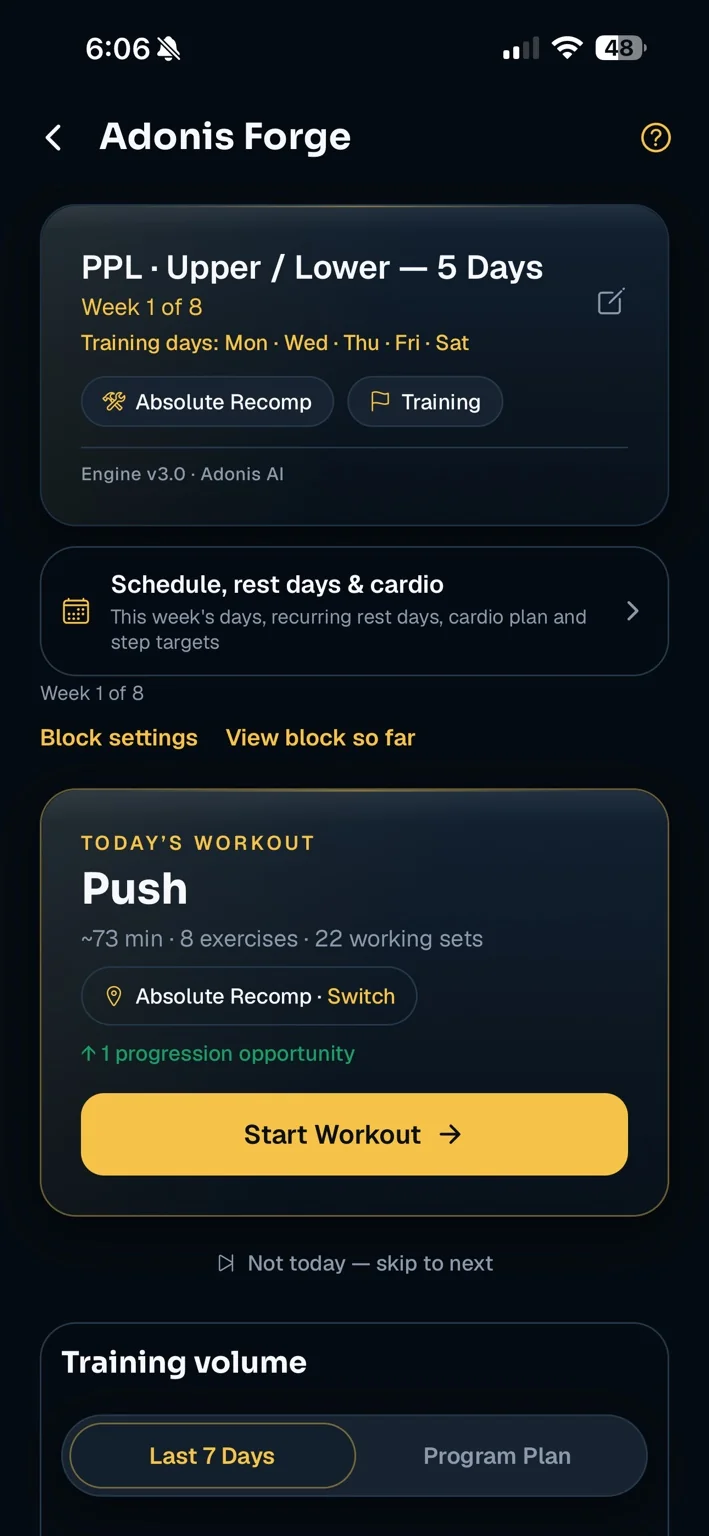
Change equipment for a session, review what you've lifted and use the prescribed targets to approach progression deliberately. Forge supports the programming; your execution and judgment still matter.
Coach Adonis: the 'why' behind the next move
Coach Adonis adds AI-powered feedback using the training, nutrition and recovery information available in AdonisIQ. When the question is bigger than whether you gained one rep, broader trends can help inform a decision.
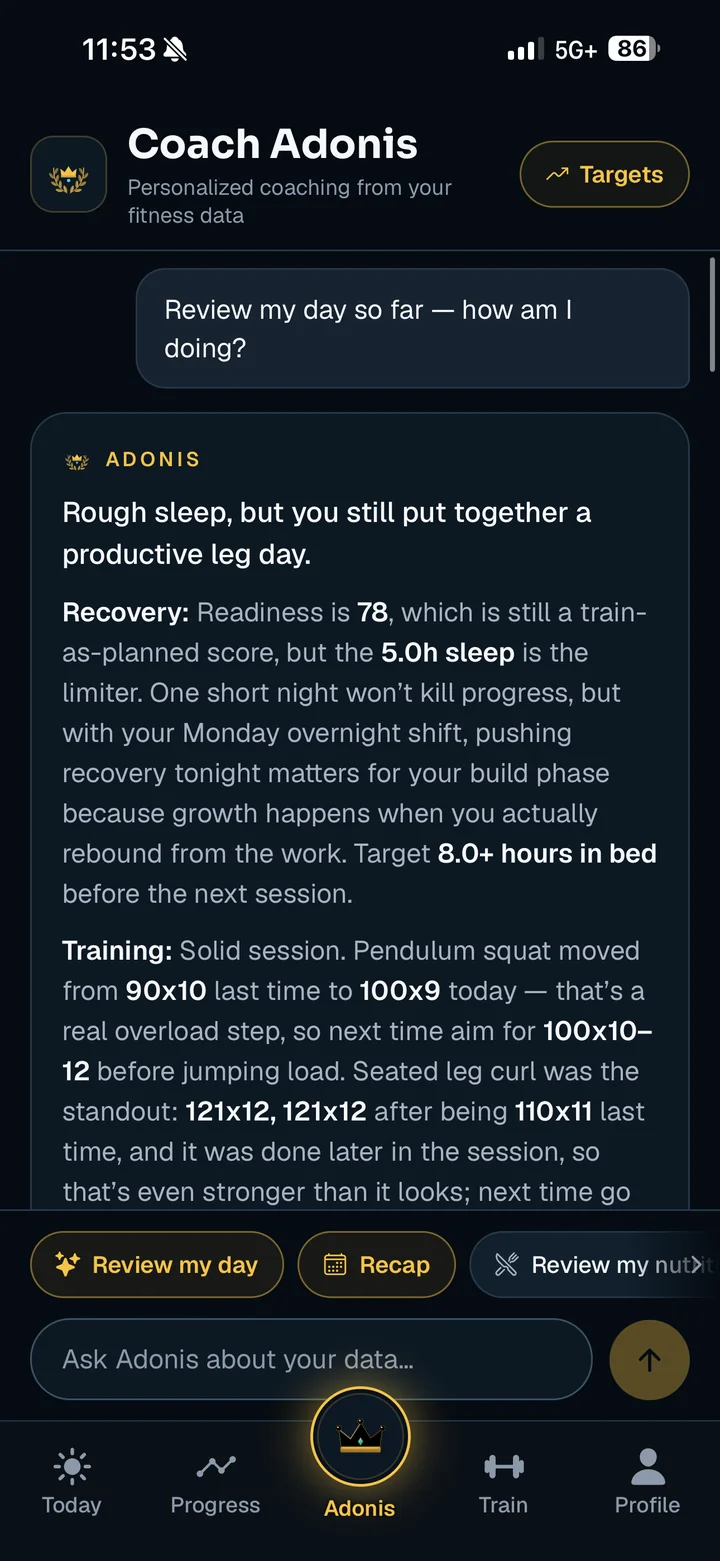
Coach feedback is not a guarantee of an optimal load, fatigue prediction or outcome. Treat it as a tool that makes the reasoning visible and helps you assess your next move.
What does the evidence say about coaching apps?
Digital guidance can be useful, but it should not be marketed as a proven replacement for coaching. A 2025 randomized trial comparing in-person supervision, app-guided training and self-guided training in 79 trained adults found strength gains in all groups, with the supervised group showing greater squat-strength improvement than the other groups. The study evaluated a particular app-guided approach—not AdonisIQ—and cannot establish that every AI coach improves results. View the trial.
A 2026 review similarly noted that commercial AI fitness systems often evolve faster than independent research can validate them. The most responsible way to use AI is as an aid to planning and interpretation, with users retaining control of decisions. Review the evidence.
Who benefits from more than workout logging?
If you already have a plan you love and only want a place to store numbers, a straightforward tracker may be enough. If you're balancing muscle growth, weight changes, training fatigue, equipment availability and progression, a connected coaching experience may be more useful.
AdonisIQ is designed for lifters who want more context around their training decisions—and for people working on body recomposition who don't want workouts, nutrition and recovery to live in separate silos.
Your workout history is the beginning—not the whole story
Recording your session tells you where you've been. AdonisIQ helps you put that history to work. Use Adonis Forge to organize training and Coach Adonis to help interpret progress, nutrition and recovery. Then decide your next move with a clearer picture.
Get AdonisIQ for iPhone ↗ Explore Android access ↗
Availability and subscription terms are shown in the app or store. AdonisIQ provides fitness guidance, not medical diagnosis or treatment.
Frequently asked questions
Can an AI workout coach replace a personal trainer?
No. An AI coach can assist with planning and interpreting data, but cannot replicate real-time technique assessment, hands-on supervision or individualized clinical judgment. For that comparison, read AI fitness coach vs. personal trainer.
Does a workout tracker support progressive overload?
Yes. A reliable workout log provides the foundation for progressive overload. Coaching helps decide which variable to progress and when.
Does Adonis Forge automatically know when I'm recovered?
No system knows your exact readiness. AdonisIQ uses available data to add context, and you should consider how you actually feel and perform.
Is AdonisIQ only for advanced lifters?
No. It is designed to support goal-based training and fitness decisions for users with different experience levels.
Keep learning: RIR and RPE explained · Weekly training volume · How AdonisIQ connects your fitness data.
Educational material only. Training decisions should account for your abilities, safety and individual circumstances.