 AdonisIQ
You open AdonisIQ and see a number out of 100. Some mornings it is higher than you expected. Other days you did everything you could and still wish it were better. What does that number actually mean?
The AdonisIQ Score measures your consistency with daily habits that support your fitness goal. It is a simple way to spot where your routine is on track and where you may need more consistency. It is not a medical measurement, a fitness test, or a prediction of whether you should train hard today.
Key takeaways
- It is a goal-consistency score from 0 to 100. The number summarizes how closely your tracked habits align with your goal.
- The score draws on five habit areas: nutrition, training, sleep, steps, and weigh-ins.
- 80 or higher is a green day. AdonisIQ shows your streak of consecutive green days.
- Look below the headline number. Category scores and seven- and 30-day averages offer more context than a single day.
- Use the score to improve one behavior. Do not add unnecessary workouts or restrict food just to increase a number.
What does the AdonisIQ Score actually measure?
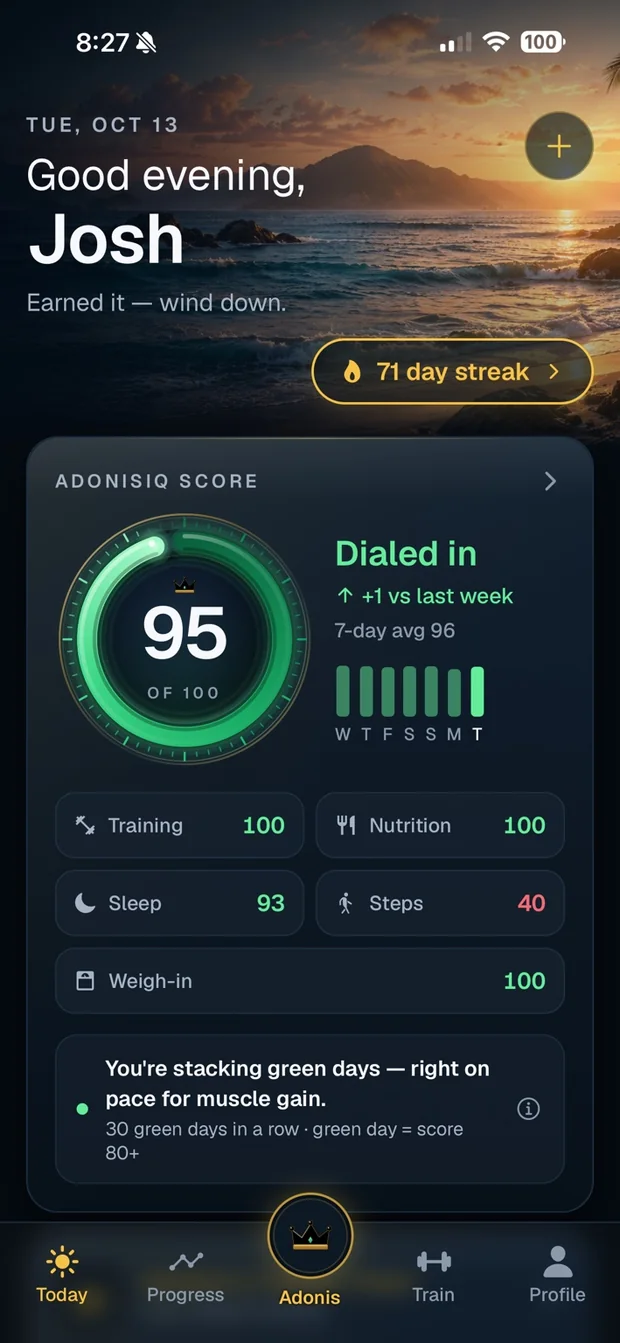
AdonisIQ describes the number as today's goal-consistency score: how consistently you are hitting the habits that help move you toward your chosen goal. Rather than attempting to judge your worth or physical condition, the score offers a quick summary of behaviors you can review and improve.
The Today screen breaks the score into underlying categories. These correspond to the habits AdonisIQ highlights in its green-day explanation:
| Habit area | What to focus on |
|---|---|
| Nutrition | Log food intake accurately and work toward the nutrition targets appropriate for your goal. |
| Training | Follow your intended training schedule and log completed work consistently. |
| Sleep | Track sleep when available and support a repeatable sleep routine. |
| Steps | Monitor daily movement relative to the activity target in your plan. |
| Weigh-ins | Record bodyweight consistently enough to understand longer-term trends, rather than judging one reading. |
These categories help explain the number, but they are not a published formula for calculating it. AdonisIQ does not need you to reverse-engineer scoring weights. What matters is whether the dashboard is pointing toward a useful daily action.
Is it a recovery or readiness score?
No. The AdonisIQ Score is primarily about goal consistency, not biological training readiness. This is an important distinction.
Sleep and other wellness information can help put training decisions into context, but a single goal-consistency number does not tell you whether your nervous system is recovered, whether you are getting sick, or whether a particular workout will be safe or productive. A high score does not mean you should add extra sets; a lower score does not automatically mean you need a rest day.
For decisions about training stress, compare the score with your workout performance, how you feel, sleep trends, and any other relevant context. Our Apple Watch training-plan guide and HRV guide explain why single wearable measurements should not dictate your entire training plan.
What is a green day in AdonisIQ?
In AdonisIQ, a green day is any day your Score reaches 80 out of 100 or higher. The app displays a green-day streak, showing consecutive days that reach that threshold.
Think of a green day as a reminder that you followed many of the habits supporting your goal—not proof that your fitness improved overnight. A streak can be encouraging, but it should not become a reason to chase the score at the expense of sensible training, recovery or nutrition.
How to read a high, low or unchanged score
High score: recognize the consistency
A high score indicates that your tracked habits aligned well with your goal that day. Keep the routine sustainable. Do not pile on more exercise simply because the number is high.
Low score: check the breakdown before reacting
Open the Score details and look for the categories with the lowest values. Maybe you missed a nutrition log, fell short of your activity target, or had an unusually disrupted routine. The next step is to identify a manageable action—not to punish yourself with extra cardio or drastic dietary changes.
Unchanged score: compare longer-term trends
An unchanged score does not necessarily mean your physique or performance has stalled. Your habits could be consistent while your strength or body composition changes gradually. Compare the app's seven- and 30-day averages, then review your actual training and bodyweight trends.
Why did my score move?
Several everyday factors can affect the picture the app sees. Your routine may have changed, your entries may be incomplete, or information may not have synced yet. Since the score reflects tracked behavior, it cannot reliably interpret a day you did not record.
That is why cleaner data is more useful than a temporarily higher number. Enter what really happened. Do not create extra workouts or log food you did not eat to make the dashboard look better.
Your broader circumstances also matter. A travel day, family emergency, illness or stressful work shift could change what is feasible. A number can highlight a pattern, but it cannot understand every detail of your life without additional context.
How to improve your AdonisIQ Score without chasing points
- Open the Score breakdown. On the Today screen, tap the score to see the underlying category scores and recent averages.
- Look for the biggest practical gap. Is one category repeatedly lower than the others? Focus there instead of changing everything.
- Check your logs. Confirm your workout, nutrition, steps, sleep and weigh-in information reflect what actually happened.
- Make one sustainable adjustment. A more regular bedtime, improved meal logging, or more consistent movement may be a better starting point than a drastic training overhaul.
- Ask Coach Adonis for context. The app includes a How do I improve my score? action that can bring your score and weaker areas into a coaching conversation.
- Review the pattern. Use the seven- and 30-day score averages alongside strength, bodyweight and other goal-specific outcomes.
If you are adjusting a training program, use the score as supporting context, not the sole instruction. The same principle applies to nutrition: hitting your goal consistently matters more than chasing an attractive number. Explore our body recomposition training guide and nutrition decision rules for practical planning examples.
Frequently asked questions
What is a good AdonisIQ Score?
An AdonisIQ Score of 80 or higher qualifies as a green day in the app. Rather than treating a lower number as failure, review the breakdown and the trend over time.
Is the AdonisIQ Score the same as an Apple Watch readiness score?
No. AdonisIQ's number is a daily goal-consistency measure, whereas wearable readiness metrics are typically intended to describe aspects of physiological recovery. They answer different questions, and neither should replace your own judgment.
Why did my AdonisIQ Score drop after a good workout?
One good workout is only one part of your broader routine. Your score also reflects other tracked habits. Open the category breakdown rather than assuming your workout caused the change.
Does a low score mean I should skip training?
Not automatically. Consider your planned session, energy, symptoms, performance and recent workload. If you have concerning symptoms or a medical issue, seek individualized professional guidance rather than relying on a score.
How do I improve my score?
Tap the score on the Today screen, review the category breakdown, and use How do I improve my score? to discuss your weakest areas with Coach Adonis. Improving accurate, sustainable habits is the point—not gaming the system.
Can a 100/100 score tell me I am gaining muscle or losing fat?
No. The score summarizes goal-supporting habits, not direct proof of physiological change. Strength trends, progress photos, bodyweight averages and other relevant outcomes help determine whether your plan is working.
The number is a tool, not a verdict
You already collect plenty of information about your training and nutrition. AdonisIQ brings those daily behaviors into a single score, shows what is contributing to it, and gives you a way to ask for the next sensible action.
Read the score like a useful dashboard: check the headline, inspect the categories, and keep your attention on the pattern—not on one imperfect day. Consistency is the goal. The score is a way to see it.
Your data. Your next move.
Connect your habits to the bigger picture. Track training, nutrition, and progress with the AdonisIQ Score and ask Coach Adonis what to prioritize next.
Try AdonisIQ free for 14 days ↗